Which post and rail fence suits your field, paddock or smallholding?
Post and rail is timber posts with two to four horizontal rails, often with stock wire stapled along it to keep sheep, dogs or young stock in. It suits fields, paddocks, smallholdings and long boundaries on open, wet or windy ground. Closeboard is the better choice where you need privacy or a solid screen near the house.
What is post and rail fencing, and what is half-round rail?
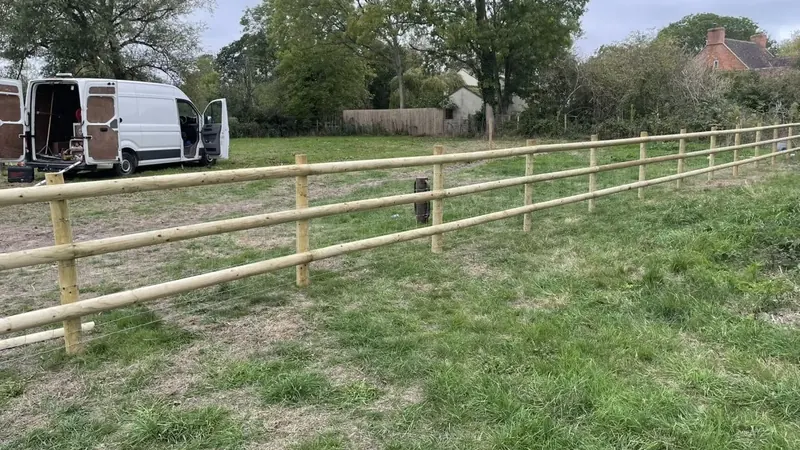
Post and rail fencing is a row of timber posts with horizontal rails fixed across them. Sawn rails are square-edged planks; half-round rails are poles cut lengthways, so they have a flat back against the post and a rounded face outwards. Both are used across Somerset for fields, paddocks, smallholdings and rural garden boundaries.
The parts are simple: line posts along the run, rails fixed to them, and heavier posts at the ends, corners and gateways. Where wire is added, those end and corner posts take the strain of the tensioned wire, and they are usually braced with a strut.
| Sawn rail | Half-round rail | |
|---|---|---|
| Shape | Square-edged plank | Pole cut in half: flat back, rounded front |
| Look | Neat and formal, a classic paddock rail | Softer and more rural |
| Common use | Paddocks, drives, garden fronts | Fields, smallholdings, stock fencing with wire |
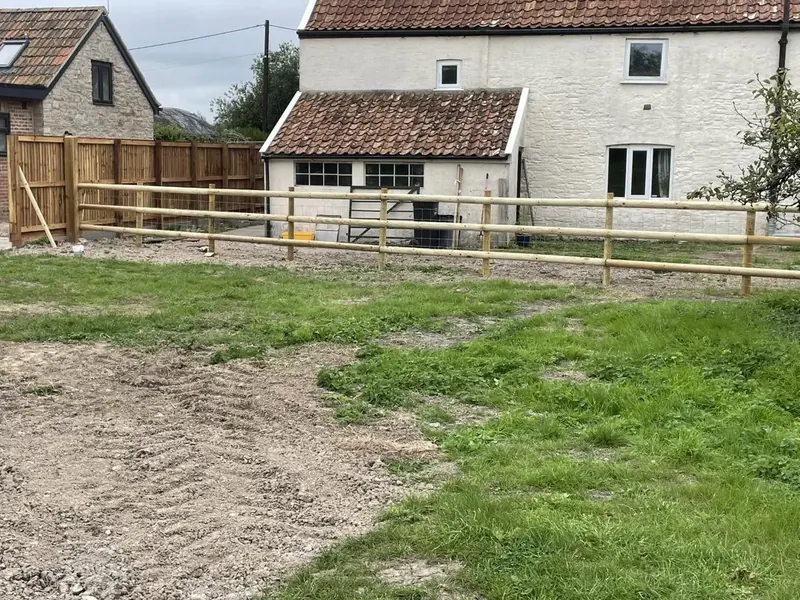
We put up both. On the Levels side of Axbridge we have fitted 50 m of post and half-round rail with stock wire at Mark, and 45 m of post and rail finished with a 12 ft field gate at Rooksbridge.
How many rails does a post and rail fence need?
It depends on what the fence has to hold. Two rails mark a boundary and carry stock wire well. Three rails is the usual choice for a horse or pony paddock. Four rails suits small ponies, foals or a taller fence. Height matters as much as rail count, so start with the animals and work back.
| Rails | Typical use |
|---|---|
| 2 rails | Field and garden boundaries; with stock wire for sheep and dogs |
| 3 rails | Horse and pony paddocks |
| 4 rails | Small ponies and foals, or where a taller fence is needed |
For horses, Defra's code of practice quotes the British Horse Society's guide heights:
The British Horse Society (BHS) generally recommends that fences should be 1.25m (4ft) high more specifically: Horses: fence height should be 1.08m to 1.38m (3ft 6ins to 4ft 6ins). Ponies: fence height should be 1m to 1.3m (3ft 3ins to 4ft 3ins).
One detail worth asking about: on a paddock, rails are normally fixed on the side the animals are kept, so a horse leaning on the fence pushes the rail against the post rather than off its nails.
Do you need stock wire on a post and rail fence?
Add stock wire if the fence has to hold sheep, lambs, goats or dogs, because they walk straight between rails. Stock wire is a woven mesh stapled to the posts, with smaller gaps at the bottom. For horses on their own, rails are usually enough, and Defra's code warns against sheep wire and barbed wire in horse fields.
Many Somerset fields are grazed by more than one kind of animal. The Defra code covers that case too:
Barbed wire/ sheep wire ideally should not be used in fields used by horses and where plain wire is used, measures should be taken to ensure it is sufficiently visible to the horse. If because of the cross grazing of other stock the use of barbed wire or sheep wire is essential it should be kept tight and well maintained. Sheep wire is available with gaps that are smaller at the bottom which is much less likely to injure a horse.
- Sheep and lambs: stock wire close to the ground, usually with a rail on top.
- Dogs: stock wire helps, but a dog that jumps needs a taller fence, not just more mesh.
- Horses only: rails alone, or rails with an electric line if they lean on the fence or chew it.
- Mixed grazing: smaller-gap wire at the bottom, kept tight, as the code describes.
What size field gate do you need?
Measure the widest thing that has to come through, whether that is a tractor, a trailer, a horsebox or a hedge cutter, and allow room to turn in. A 12 ft gate is a common choice for field access with machinery. The gate is only as good as its hanging post, which carries the weight every time it swings.
- Check the turning circle as well as the width: a gate set off a narrow lane needs more room than one on a straight track.
- Ask which way it will open. Many field gates open into the field, so stock pushing against them cannot force the latch.
- Hanging posts are normally the heaviest posts in the run and are set deeper than line posts.
- Agree the latch and any padlock at the start. Defra's horse code says gates should be fastened securely to prevent injury and escape.
When is post and rail better than closeboard?
Post and rail is better for long runs, livestock, open views and wet or windy ground, because wind passes through it and each post carries little load. Closeboard is better next to the house, where you want privacy, a solid screen or a barrier a child or dog cannot see through. Many rural properties use both.
| Post and rail | Closeboard | |
|---|---|---|
| Privacy | None: you see straight through | Full screen |
| Wind | Passes through | Takes the full force, so posts must be strong |
| Wet ground | Light load on each post | Heavier; boards must be kept off the soil |
| Livestock | Yes, with stock wire where needed | Rarely used for fields |
| Long runs | Less timber per metre | More timber per metre |
| Best for | Fields, paddocks, smallholdings, open garden boundaries | Gardens, yards, roadside boundaries |
A common pattern on smallholdings around Wedmore and Cheddar is closeboard around the garden and yard, and post and rail with stock wire from there out to the fields. If you want shelter without a solid face, a hedge planted behind post and rail gives it over a few seasons.
What affects the cost of a post and rail fence?
The length of the run, the number of rails, whether stock wire goes on, and how many corners, ends and gateways there are drive most of the cost. Ground and access come next: stony ground, soft clay and a site machinery cannot reach all add time. The fairest way to compare quotes is on the same written specification.
- Length and rail count: more rails and more metres means more timber and fixing time.
- Stock wire: an extra material, plus straining at every end and corner.
- Corners, ends and changes of direction: each one needs a heavier, braced post.
- Gates: the gate itself, its hanging and shutting posts, and the hardware.
- Ground: stone near the surface on the Mendip side, or wet clay on the Levels.
- Access and clearing: an old fence to take out, or a hedge or brambles to cut back first.
Check that each quote names the post size and treatment, the rail type and count, the wire, the gates and who clears the old line. Two quotes for "post and rail" can describe very different fences.
Do you need permission for a field fence or gate?
Usually not for the fence itself. A fence or gate up to 2 m high, or 1 m next to a road used by vehicles, normally needs no planning permission. The checks that catch people out are listed buildings, public rights of way across the field, and taking out an old countryside hedge to make way for the fence.
it is next to a highway used by vehicles (or the footpath of such a highway) and it would not exceed one metre in height (from ground level); or it would not exceed two metres in height (from ground level) if elsewhere
If the new fence replaces a field hedge, check before anything is grubbed out. gov.uk says: "There are rules you need to follow if you intend to remove a countryside hedgerow. You could get an unlimited fine if you break these rules."
Questions people also ask
How long does a post and rail fence last?
It depends on the timber, how it was treated and the ground it stands in. Posts usually fail first, at the soil line, and wet ground shortens their life. Ask any fencer which treatment the posts have and whether they are rated for ground contact.
Can you have post and rail fencing in a garden?
Yes. Two-rail post and rail suits front gardens, cottage boundaries and gardens that look out over fields, where you want a clear edge without blocking the view. It gives no privacy, so many people pair it with a hedge.
Do you fence farms, paddocks and larger sites?
Yes. We cover a 10 to 15 mile radius around Axbridge for every service, take larger business and farm jobs on request, and put up fencing and decking in and around Somerset. Our farms and businesses page has more on larger jobs.
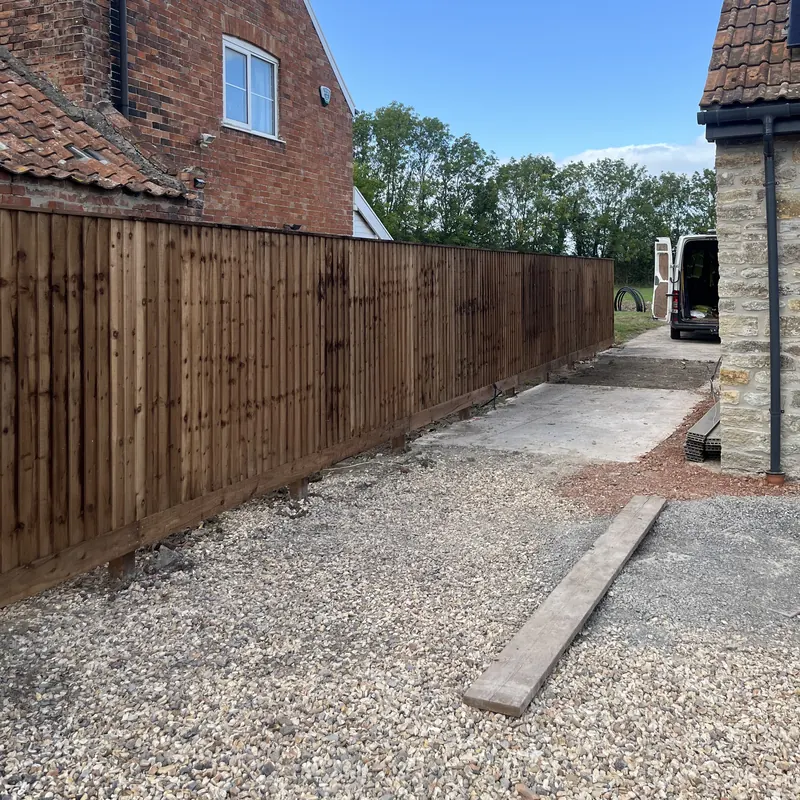
Fencing from a family business near Axbridge
We put up post and rail and half-round rail fencing, with stock wire and field gates, in and around Somerset, and take on larger farm and business jobs on request; call or WhatsApp 07594 230584 for a free quote, emailed or given on the day.
We put up 50 metres of post and half-round rail with stock wire at Mark. More on fencing and garden work in Mark.
Sources
- Defra: Code of practice for the welfare of horses, ponies, donkeys and their hybrids (paragraphs 1.8 and 1.9), accessed 23 October 2026
- Planning Portal: Fences, gates and garden walls, planning permission, accessed 23 October 2026
- gov.uk (Defra and Natural England): Public rights of way, landowner responsibilities, accessed 23 October 2026
- gov.uk (Natural England and Defra): Countryside hedgerow protection, removing hedgerows, accessed 23 October 2026
Rules and wildlife law are quoted from the official pages above. This guide is general advice; check the source for your own situation.