How do you stop decking going slippery and green in winter?
Decking goes green and slippery in winter because it stays wet, shaded and covered in leaves, and algae grows on the damp surface. Keep it clear of leaves, open the gaps between boards so water drains, keep air moving underneath, and give it a scrub and a treatment on a dry day before the hard frosts arrive.
Why does decking go green and slippery in winter?
Timber decking goes green in winter because it rarely dries out. Short days, low sun, wet leaves and blocked board gaps keep the surface damp, and algae grows on it as a thin film. Wet algae is slippery underfoot, which is why a deck that is fine in August can be hard to stand on by December.
Somerset gives algae a long season. The Met Office notes that across the South West the highest rainfall comes in December and January, and that frost can be more common inland than the region's mild reputation suggests.
The highest rainfall is in December and January when the sea is relatively warm still and the Atlantic depressions are most vigorous.
Where the deck sits matters as much as the weather. A north-facing deck against the house, one under trees, or one on low wet ground on the Levels will stay damp for weeks at a time. Decks on the Mendip slopes get more rain still: the Met Office puts annual totals on the Mendip Hills above 1,100 mm, against about 700 mm on the low ground of central Somerset.
- Shade from the house, fences, hedges or trees
- Leaves and soil packed into the gaps between boards
- Little or no air moving under the deck
- Water sitting on the ground beneath it, common on clay
- Old treatment worn off, so the timber soaks up water
What should you do to your decking before the frost?
Before the first frosts, sweep the deck clear of leaves, rake the gaps between the boards open, scrub off any green film with a stiff brush and a deck cleaner, and treat the boards on a dry day. In inland Somerset the Met Office says the first air frost usually comes around mid October, so the job is due now.
The first air frost of autumn can be expected about mid October inland in Somerset.
- Sweep off leaves, moss and soil with a stiff broom, along the boards rather than across them.
- Run a thin scraper or putty knife down each gap so water can drain through.
- Scrub any green patches with a stiff brush and a cleaner made for decking, then rinse.
- Leave it to dry for a few days, then apply a decking oil or treatment if the old one has worn off.
- Check the tin before you start: most treatments need a dry spell and a minimum temperature to soak in and cure.
How does drainage and airflow keep decking dry?
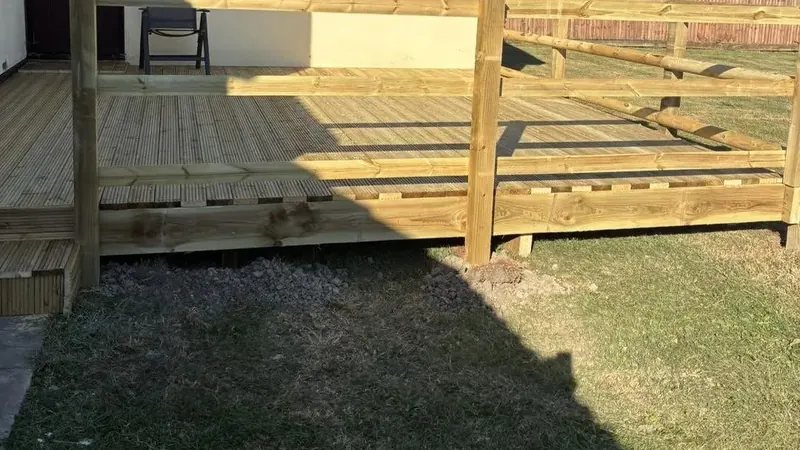
A deck dries from both sides. Rain should run off the top and drop through the gaps between boards, and air should move freely underneath so the boards and joists dry between showers. Blocked gaps, boarded-in sides and puddles on the ground below all hold moisture against the timber, which feeds algae and, over time, rot.
On the Levels, where the ground lies just above sea level and the clay holds water through winter, the space under a deck can stay wet for months. You cannot change the ground, but you can stop making it worse.
- Keep the sides of a raised deck open, or use slatted skirting rather than solid boards.
- Do not store logs, bags of compost or garden furniture covers tight against the sides.
- Cut back shrubs and climbers that lean over the deck and drip on it.
- Clear leaves from underneath as well as on top if you can reach.
- Look for puddles on the boards after rain: a deck should shed water, not hold it.
If water pools in the same place on the boards every time it rains, a board may have cupped or the frame may have settled. That is worth checking before winter rather than after it.
How do you make decking less slippery when it is icy?
On frosty mornings, the safest deck is a clean one: algae under frost is the worst combination. Keep a stiff broom by the door, sweep off frost and snow early, and add grip where people walk most, such as the steps and the route to the back door. Anti-slip strips or rubber mats on steps help a lot.
| Option | Good for | Watch out for |
|---|---|---|
| Anti-slip strips on steps | Steps and the main walking line | Need fitting to clean, dry boards |
| Rubber mats | Doorways and the bottom of steps | Lift them now and then so the boards underneath can dry |
| Sand or grit on a frosty morning | A quick fix for the walking line | Sweep it off afterwards so it does not pack into the gaps |
| De-icer or salt | Ice that will not shift | Check with the board maker first; some products mark timber or composite |
Composite boards are not immune. They do not soak up water like timber, but algae and frost still sit on the surface, and smooth boards can be just as slippery when wet. The same sweeping and cleaning applies.
When is a winter deck beyond cleaning?
A deck is beyond cleaning when the timber itself has gone. Boards that feel soft or spongy, split along their length, bounce when you step on them, or have screws that turn without biting point to rot in the boards or frame. Cleaning will not fix that. A weak board on a raised deck is a fall risk.
- Push a screwdriver into the board near the joists: if it sinks in easily, the timber is soft.
- Look at the posts and joists underneath, especially where they meet the ground.
- Walk the deck slowly and feel for bounce or movement.
- Check steps and handrails for any looseness.
If you are planning a replacement for spring, winter is a good time to think about the size and height. Planning rules apply to raised decks. The Planning Portal says decking is generally allowed without planning permission only where it sits low to the ground and covers no more than half the garden, and none is allowed in the grounds of a listed building.
The decking is no more than 30cm above the ground
If your deck would be higher than that, or you live in a listed building or a protected area, check with Somerset Council's planning team before any work starts.
Questions people also ask
Should I cover my decking in winter?
Usually not. A tarpaulin or cover traps moisture against the boards and stops air getting to them, which is what you are trying to avoid. Keeping the deck clear and the gaps open does more good.
Can I treat decking in winter?
Most decking oils and treatments need a dry surface and a mild spell to soak in and cure, so the cold, wet months are a poor time. Check the tin for the minimum temperature. If you miss the autumn window, clean the deck now and treat it on the first dry spell in spring.
Is pressure washing bad for decking?
It can be if the nozzle is held too close or the pressure is too high, as it can rough up softwood and lift the grain. A stiff brush with a cleaner made for decking is gentler and usually enough. If you do use a pressure washer, keep it moving and well back from the boards.
Can you help with an old or unsafe deck?
We build raised timber decking. If your deck is soft, rotten or unsafe and needs replacing, we can give you a free quote for a new one; for anything else, ring and tell us about it.
Why is my composite decking slippery?
Composite boards still collect algae, leaves and frost on the surface, and their smoother finish can be slippery when wet. Sweep them often, wash off any green film with a cleaner the maker approves, and add grip strips to steps.
Decking from a family business near Axbridge
If your deck is past saving, we build raised timber decking around Axbridge and further across Somerset, with a free quote emailed or given on the day.
We built a raised timber deck at Rooksbridge. More on fencing and garden work in Rooksbridge.
Sources
- Met Office: South West England climate (regional climate summary, 1981-2010 averages), accessed 23 October 2026
- Planning Portal: Decking, planning permission, accessed 23 October 2026
Rules and wildlife law are quoted from the official pages above. This guide is general advice; check the source for your own situation.